


Fed holds rates steady, removes easing bias language
Fed Chair Kevin Warsh's first meeting concluded on Wednesday. The decision was to keep rates unchanged and remove key language hinting at a future bias toward rate cuts, while significantly shortening the policy statement.
The FOMC voted unanimously to hold the benchmark overnight lending rate steady in the 3.5%-3.75% range. The rate has stayed at this level since the central bank cut rates by 0.75 percentage points in the second half of 2025.
Despite market curiosity and speculation about Warsh leading the central bank, the meeting followed this year's established pattern on the rate decision but differed in other respects.
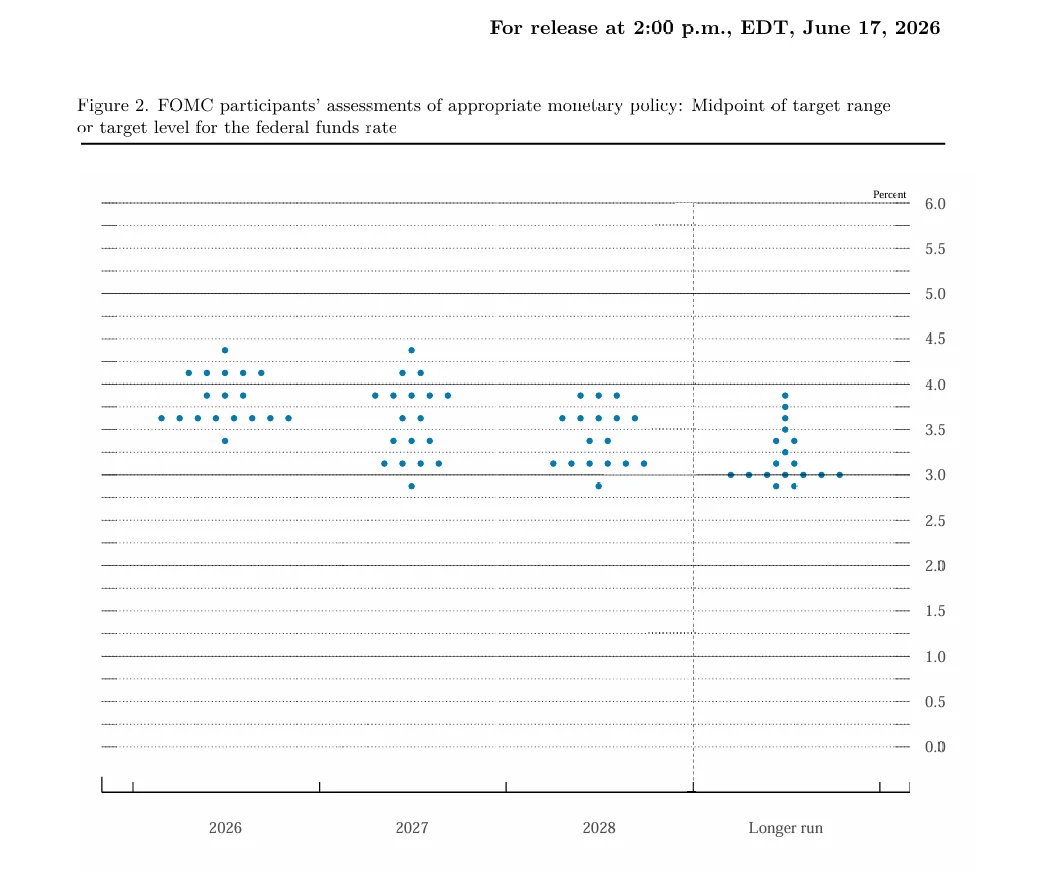
Fed officials withdrew expectations for rate cuts this year via the closely watched "dot plot" and hinted at the possibility of rate hikes, though not a certainty. However, one member's projection was missing from the dot plot, leading market observers to suspect Warsh did not submit his forecast.
A note attached to the projections showed that 18 of 19 participants submitted rate and economic forecasts. Since the dot plot is an anonymous aggregate of expectations, it cannot be confirmed if the missing one was Warsh. But before the meeting, market observers widely expected Warsh not to participate in the SEP. Some suspected he might try to abolish the mechanism entirely. Also, a dot was missing from the 2028 projections.
Warsh has been critical of the dot plot as a forecasting tool, as well as other committee forward guidance, including GDP, unemployment, and inflation projections in the SEP.
In addition to the widely expected rate decision, the FOMC's post-meeting statement not only removed language hinting at future easing but also significantly shortened the rest of the statement.
This week's statement was just 130 words, compared to 341 words in the statement after the April 29 meeting. It provided a brief summary of the economy and then committed to controlling inflation.
The statement said: "Economic activity continues to expand at a solid pace amid some degree of uncertainty, partly due to the Middle East conflict. Productivity growth and capital investment are strong. Job gains remain in line with labor force growth, and the unemployment rate has moved little."
The Committee added: "Inflation remains above the Committee's 2% objective, partly driven by supply shocks pushing up prices in some sectors, including energy. The Committee is committed to achieving price stability."
The statement also noted that the Fed would maintain its policy of "ample reserves" in the banking system, suggesting no immediate plan to shrink holdings of bonds on the central bank's $6.7 trillion balance sheet, despite Warsh's advocacy for such a move.
Previously, at the April meeting, three dissents emerged when regional bank presidents wanted to keep the option for both future rate hikes and cuts, opposing the so-called "forward guidance" language. This statement was passed unanimously.
Amid uncertain rate prospects, officials also adjusted guidance on future policy. The dot plot, which anonymously displays participants' rate expectations, erased the previous expectation of one rate cut this year and pushed any possible rate cut to 2027 and 2028, as policymakers assessed the persistence of inflation spikes from the Iran war.
The dot plot showed the median year-end federal funds rate projected at 3.8% — about 0.16 percentage points above the current level, suggesting rate hikes are fully under consideration. Officials continued to see the long-run federal funds rate at 3.1%.
Officials changed their view of the economy, raising the 2026 overall inflation forecast to 3.6% and core inflation (excluding food and energy) to 3.3%. In the previous update in March, members had forecast both at 2.7%. They also slightly lowered GDP growth to 2.2%, down 0.2 percentage points from March, and lowered the unemployment rate forecast to 4.3%, down 0.1 percentage points.
The inflation surge put policymakers in a bind, as traditional policy training calls for them to look through short-term supply shocks (such as war-related energy price spikes).
Recent inflation indicators hit multi-year highs, with the May CPI showing an annualized rate of 4.2%, though the core indicator excluding food and energy was lower at 2.9%. Inflation has been above the Fed's 2% target for the past five years.
Although Warsh has made few public comments beyond his confirmation hearing before being sworn in as chair on May 22, he has advocated looking through supply-shock inflation when setting policy. He has also insisted that AI will eventually have a deflationary effect on the economy, as productivity gains help lower costs of goods and services.
Nevertheless, the surprisingly strong labor market has complicated the case for rate cuts. May nonfarm payrolls again exceeded expectations, adding 172,000 jobs, while the unemployment rate — the Fed's most closely watched indicator — has remained unchanged at 4.3% over the past year.
Market pricing aligns with the FOMC's expectations. According to CME's FedWatch tool, markets expect no rate cuts in 2026 and project a 25-basis-point rate hike before year-end.