


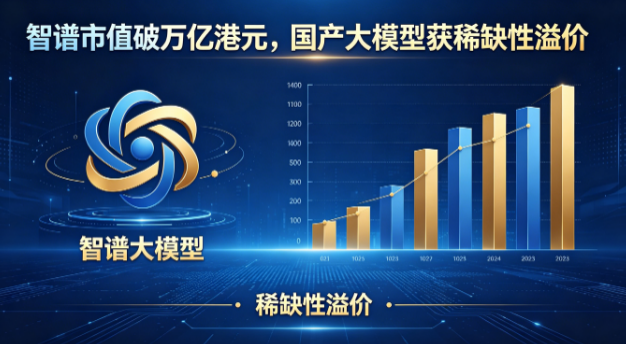
Scarcity Premium and AGI Narrative: Deep Technical Analysis of Zhipu's Trillion-Dollar Market Cap
Introduction
On June 22, 2026, the Hong Kong stock market witnessed a rare capital frenzy. Zhipu (Zhipu AI) surged over 42% intraday, hitting an all-time high of HK$2,980 per share, corresponding to a total market cap of HK$1.27 trillion. Although the closing gain narrowed to 15.09%, the closing price of HK$2,410 per share and total market cap of HK$1.07 trillion were enough to attract market attention. Even more astonishing is the time dimension: this AI large model company has been listed for less than six months, with its market cap expanding from HK$52.8 billion to HK$1 trillion, a cumulative gain of over 1900%. Amid the clash between valuation bubble theory and value discovery theory, one core question emerges: What technical logic drives Zhipu's market cap rocket? And how long can the scarcity premium behind it last?
1. Scarcity: The 'Big Model Void' in Global Capital Markets
UBS analyst's breakdown of Zhipu's valuation premium points to three keywords: global scarcity of listed model players, not yet entering lock-up expiry period, low liquidity. This is not simply market sentiment release but a profound reflection of the capital market structure in the AI industry.
From a global perspective, although there are many startups in the big model track, few have achieved stable revenue and completed an IPO. OpenAI is valued highly but has not yet entered the public market; star projects like Anthropic and Cohere remain in private financing stages; domestic giants like Baidu, Alibaba, and Tencent have proprietary models but are internal departments of their groups, lacking pure-play listed targets. Zhipu, as the first native big model company listed on the Hong Kong Stock Exchange, effectively holds the scarce position of 'first stock'. This scarcity is further amplified in the relatively low-liquidity HK market – when investors want to bet on the future of AGI but have only a few listed options, Zhipu becomes an 'isolated island' where funds are forced to surge in.
But scarcity is not an unchanging moat. As more big model companies start IPO processes (such as rumored plans for Moonshot AI, MiniMax, etc.), Zhipu's scarcity premium will face dilution. The current stock price at least contains some irrational addition from 'lack of substitution effect'.
2. Valuation Logic: Paradigm Shift from P/E Ratio to 'Dream Ratio'
Traditional valuation models (DCF, P/E) are almost ineffective for Zhipu. An AI company listed for less than half a year, with 2025 revenue still less than 10 billion yuan and R&D spending continuously rising, its static P/E ratio would be over 1,000 times based on conventional financial metrics. What truly supports the trillion market cap is the capital's forward discounting of the 'AGI narrative'.
Here we need to distinguish two types of valuation logic for large model companies: tool-type valuation and platform-type valuation. Tool-type valuation corresponds to business models like API calls, model training services, with relatively low ceilings, similar to cloud computing IaaS a decade ago, characterized by scale effects and profit margins. Platform-type valuation assumes the model will become the operating system of the digital world – like iOS/Android in the mobile internet era, mastering user entry points, ecosystem distribution rights, and data network effects. Zhipu's current market story clearly bets on the latter.
From a technical route perspective, Zhipu's GLM series large models already have international competitiveness in Chinese understanding and multimodal capabilities. Its open-source ecosystem, GLM-130B and ChatGLM series, has attracted many developers. However, whether technical leadership can translate into platform monopoly faces two key challenges: first, large models are seriously homogenized; GPT-4o, Claude 3.5, domestic Wenxin Yiyan, Tongyi Qianwen, etc., have similar performance, user switching costs are extremely low; second, the technical route to AGI has not converged; whether the Transformer architecture can lead to general AI is still debated. If new paradigms (like world models, neural-symbolic systems) emerge, existing model barriers may collapse instantly.
Therefore, the trillion market cap is essentially a market pricing of a long-term option on 'Zhipu being the first to achieve AGI and lock in an ecological niche'. The fragility of this pricing lies in the high uncertainty of AGI's implementation timeline – any delay in technical breakthroughs or outperformance by competitors could cause risk premiums to soar.
3. Liquidity Trap: 'Paper Riches' Under Low Turnover
The 'low liquidity' mentioned in UBS's analysis is another key to understanding Zhipu's stock price explosion. The HK market usually has a liquidity discount for small and mid-cap stocks, but for Zhipu, low liquidity instead acts as a lever to push up stock prices.
As of June 22, the proportion of Zhipu shares circulating in HK is only about 15% of total issued shares; the vast majority are held by the founding team and early investment institutions (such as Hillhouse, Sequoia) and are not yet tradable due to lock-up periods. This means daily tradable chips are extremely limited. When funds pour in through channels like Shanghai-Hong Kong Stock Connect and Shenzhen-Hong Kong Stock Connect, small buying orders can cause sharp stock price fluctuations. This 'small money leveraging big market cap' mechanism is similar to the GameStop short squeeze in 2021, except Zhipu has a real AI narrative behind it.
However, the liquidity trap hides risks. Once the lock-up period arrives (usually 6-12 months after listing), early investors' profit-taking intentions will be concentrated, and supply-demand dynamics may reverse sharply. How much of the current trillion market cap is 'lock-up dividend' and how much is fundamentally supported? The market needs to make a judgment in this period.
4. Sustainability Test of the AGI Narrative
Capital votes for the 'AGI narrative', but the validity of the vote depends on progress at three levels:
Technical level: Zhipu must continuously prove its model's capability in complex reasoning, multi-step planning, and general tasks surpasses peers. In particular, whether the GLM series can preempt the next generation directions like 'world model', 'embodied intelligence' will determine if it can upgrade from a big model company to a general intelligence platform.
Commercialization level: The implied annual revenue expectation for a trillion market cap is at least tens of billions of yuan. Currently, Zhipu's main revenue comes from API calls and government-enterprise projects, but API price wars have fully begun, gross margins inevitably declining. If it cannot quickly expand C-end applications (like native apps, agent platforms), revenue growth may disappoint investors.
Ecosystem level: ChatGPT's success validates the 'model + developer ecosystem' flywheel effect. Zhipu's open-source strategy has earned developer goodwill, but it has not yet formed sticky ecosystems like Hugging Face or OpenAI Plugin. How to convert open-source traffic into a commercial closed loop is key to realizing the valuation.
Conclusion
Zhipu's trillion market cap is the product of three factors stacked: scarcity, AGI imagination, and liquidity leverage. It is neither a pure bubble nor a solid value anchor, but a 'discounting body of expectations' in intense evolution. In the short term, scarcity premium will persist, especially before the lock-up expiry, stock price may continue to be driven by capital sentiment. But in the long run, the pace of technological iteration and commercial landing speed in the AI industry will ultimately determine whether Zhipu can hold its trillion market cap high ground. For rational investors, the focus should shift from 'can the stock price rise further' to 'is the model capability accelerating toward AGI' – because only real technological advances can support the eternal premium of the narrative.